In the one observational study on record, marketing firm 411 Locals tracked 85 small businesses for 30 days and found that 62% of inbound calls went unanswered. Only about 38% reached a live person. The rest hit voicemail or simply rang out.
That's not a marketing problem. That's an operating hours problem. And a caller who can't reach you is one search result away from somebody who picks up.
Why Half the Market Is Winning and Half Is Quitting
Here's what the adoption data reveals right now.
A 2026 Adobe study of 431 small business owners found that 47% reported increased revenue since adopting AI tools, with an average self-reported increase of 21%. In the same window, S&P Global Market Intelligence surveyed 1,006 IT and business leaders and found that 42% of companies abandoned most of their AI initiatives, up sharply from 17% the year before.
Those two findings exist simultaneously, about the same technology, in the same economy.
The difference is not the tools. It's the deployment strategy. The owners seeing the gains treated their first AI deployment like a strategic hire: clear job description, defined success criteria, one specific problem to solve. The ones who abandoned it treated it like a software subscription: install, hope, cancel when nothing happened.
Your First AI Employee Isn't a Generalist
This is the mental model that breaks most deployments before they start.
People hear "AI employee" and picture a Swiss Army knife: a digital worker that handles email, answers questions, schedules meetings, drafts proposals, and does the books. That is not what you are deploying. That is what you wish you were deploying. What you are actually getting is more like a new hire who is exceptionally good at exactly one thing, never gets tired, and works every hour you are not there.
The distinction matters because it changes what you are looking for.
The businesses winning with their first AI employee picked the job their business was consistently losing: the phone that rings at 7 PM when the owner is on a job site. The appointment that never gets booked because no one answered on Saturday morning. The same five customer questions that eat an hour and a half every week. They found the thing leaking the most energy or revenue, gave it to an AI agent, and let it own that lane.
An IDC study commissioned by Microsoft, covering more than 4,000 business leaders, found companies realize an average return of $3.70 for every $1 they put into generative AI. That kind of return shows up in narrow, well-defined deployments. It collapses when businesses deploy AI to do everything and measure nothing.
The Cost Math Most Owners Are Calculating Wrong
Most small business owners compare the cost of an AI employee against the cost of a human employee. That is the wrong comparison.
The right comparison is: what does a missed call actually cost you?
You don't need an industry study for this one. Run it on your own numbers. A home services contractor doing plumbing, HVAC, or landscaping work runs on job values of $200 to $1,500 per call. Miss 10 calls a month to voicemail because you're on a job, close even a third of them, and you're looking at real money walking to whoever answered instead. Do that arithmetic with your own average ticket and your own missed-call count, because your number is the only one that matters.
Then compare it to what answering costs. AI phone-answering services run a few hundred dollars a month at most tiers. The median U.S. receptionist earns $37,230 a year, according to the Bureau of Labor Statistics, before benefits, payroll taxes, and overhead push the real employer cost higher. That gap is the whole argument, and it holds for a role that works every night, every weekend, and every holiday.
The honest caveat: most of the eye-catching "AI receptionist lifts bookings by X percent" figures floating around are vendor marketing with no study behind them. What is defensible is simpler. Calls that used to go to voicemail get answered, and some of those calls turn into booked work.
In a March 2026 SBE Council survey of 517 small employers, owners using AI reported saving a median of 5 hours a week themselves, and 16.5 hours per business once employee time savings were counted. That's capacity going back into selling, serving clients, and building instead of answering the same questions on repeat.
What Enterprise Figured Out That Most SMBs Skip
Here is the part nobody mentions when they sell you on AI tools.
Large enterprises learned years ago, through ERP rollouts, CRM deployments, and cloud migrations, that technology without governance fails quietly. The system goes live, nobody defines what "working" looks like, six months pass, and the initiative dies not because it failed but because nobody could confirm it succeeded.
The Fortune 500 calls this IT governance. For a small business, the version is simpler. But the principle is identical.
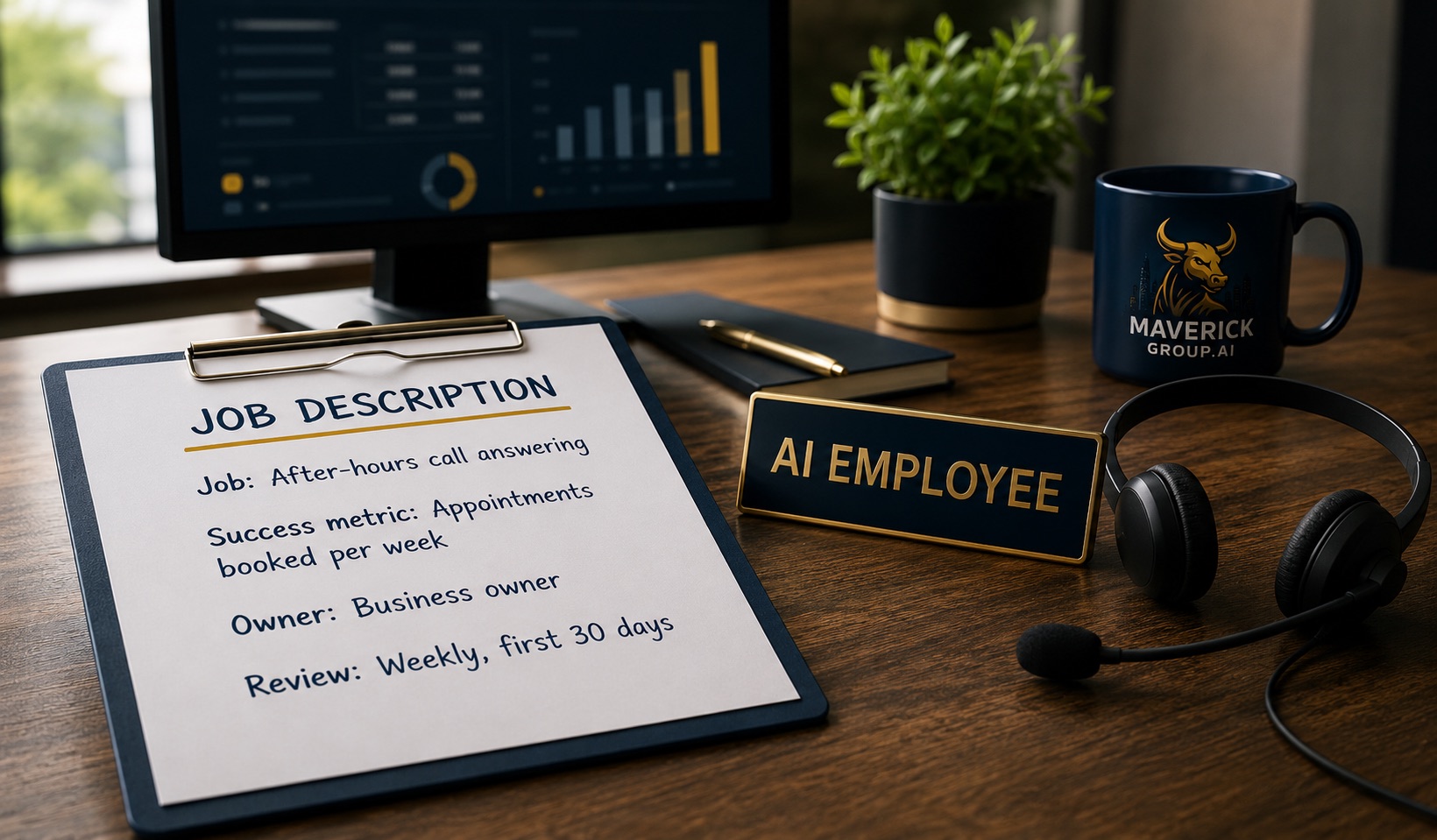
Before you hire your first AI employee, answer three questions:
What specific job is it taking over? Not "customer service." The specific job: after-hours call answering, new client appointment booking, follow-up texts after a quote is sent. Narrow it until it reads like a real job description.
How will you know if it's working? One metric. Call answer rate. Appointments booked per week. Time-to-first-response. If you cannot measure it, you cannot manage it, and you will cancel something that is working fine.
Who owns it? In a small business, that is usually the owner. But someone checks it weekly for the first month. Not to babysit it, to confirm it is doing what you configured it to do.
The businesses that skip these three questions end up in that 42% who walked away. The ones that answer them end up in the 47% reporting more revenue.
One Job, One Metric, Then the Next One
An AI employee is not a solution. It is a system you deploy against a specific, recurring problem, and it compounds when you treat it that way.
The business owners who will look back on 2026 as the year things shifted did not install the most AI tools. They picked one job that was costing them real time or real revenue, deployed an AI agent to own it, set up a way to measure it, and moved on to the next one.
That is how enterprise does it. That is how lean AI-first businesses do it now.
The job description for your first AI employee is not written in a software platform. You write it the same way you would think through any hire, except this one works 24 hours a day and never calls in sick.