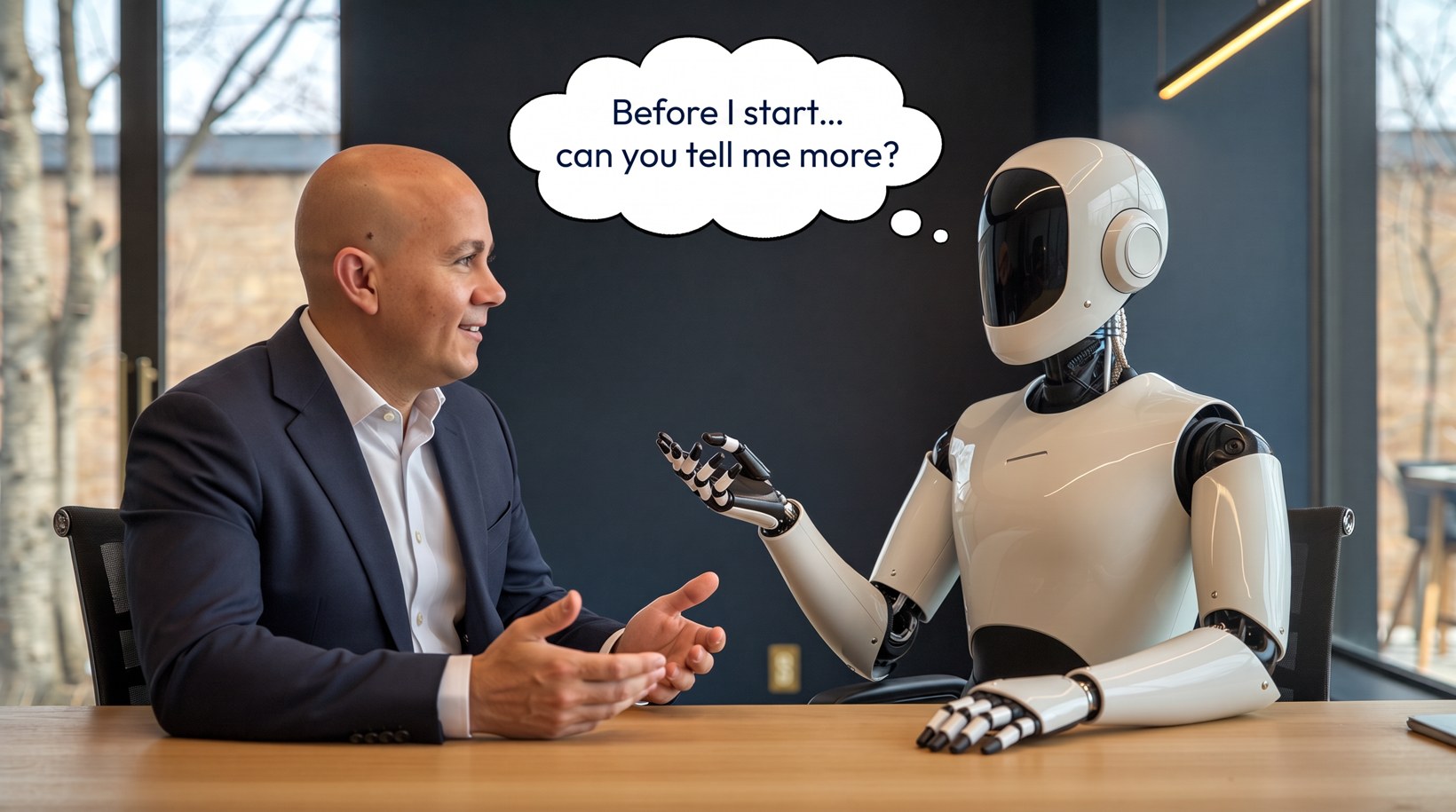
Every few weeks a business owner tells me they need to get better at writing prompts. I tell them the AI should be doing that work. On my own team of AI employees, nobody is expected to hand over a perfect brief. The AI interviews them first, then writes its own instructions. I call this reverse prompting, and it's the standard every AI employee I build has to meet.
Reverse prompting puts the hard part on the AI
Here's the plain definition. Reverse prompting means the AI asks you short questions about your request, one at a time, until it knows enough to write its own prompt. Then it does the work.
Most AI advice goes the other way. The courses and cheat sheets all teach you to write a better prompt, and that assumes the person asking knows which details matter. A busy owner usually doesn't. Neither does the office manager who was told to "try the AI thing" between phone calls. They'll know the right result when they see it, but you can't expect them to predict every decision the AI will run into along the way.
Software companies are starting to notice. In May 2026 the analytics company Holistics released a feature it calls "AI that Asks Back," where its assistant asks clarifying questions to understand what you mean before it answers. I'm glad to see it. My view goes a step further: for real business work, asking first should be the default.
One short question works better than a long form
Charlotte builds web pages on my team. When you ask her for a page, she doesn't start building and she doesn't hand you a questionnaire. She asks one thing: do you want to start from one of our built-in templates, from a few sites you like for inspiration, or a mix of both?
That's her whole first question.
Your answer shapes the next one. Choose inspiration and she asks for the links. Choose a template and she asks which feels closest to your business. Every question is short, and each one builds on what you just told her.
I tested the other approach myself. An earlier version showed me a long list of starting looks all at once, and even I wasn't sure which one to pick, and I'm the person who designed it. That told me everything. If the owner of the system hesitates, a client will too. So the standard on my team is one question at a time, because that's how a good consultant interviews you.
A good interview also tells you what happens next
Echo handles social posts. The request she hears most is some version of "make me a post and an image," and people usually expect both to be perfect on the first try.
So Echo tells you up front how she works: the words come first, and the image only gets made after you've approved them. An image built around a draft caption is built around words that might still change, and that one sentence of expectation-setting saves everybody a round of edits.
Once you've approved the words, she asks how you want the image to look. You can describe it, or she can plan it from the post. Some people already have a picture in their head. Plenty don't, and they're happy to let her suggest one. Either answer is fine, as long as she asks and doesn't guess.
Reverse prompting covers more than gathering facts. Part of the interview is telling the person what's coming, so the result doesn't surprise them.
When the price changes, the person paying gets to choose
Some requests can be done more than one way, and the ways don't cost the same. Images are a good example, because different tools give different results at different prices.
My rule is strict. When a request has options like that, the AI employee asks. It shows what each option would cost for this specific request, recommends one and says why, and then the person picks. Reading something like "Two ways to make this graphic, here's the cost of each, and I'd pick the cheaper one because it's a plain text design" takes about ten seconds. It respects the owner's money, and over time it teaches them how the work actually gets done.
Think about how contractors work. A good one walks the job before quoting. They open the cabinets, ask what you're trying to fix and what you'd like to spend, and only then write a number down. A bad one sizes it up from the driveway, guesses, and bills you later for the rework. An AI that works from a thin request is the driveway contractor.
To be fair, some experienced users say the fix is a tighter brief up front, and that works if you're a developer who knows exactly what you want. Most of the owners I talk to don't have time for that, and they shouldn't need it.
Asking first is how an AI employee earns trust
Put these together and you get one standard: the AI employee does the interviewing. Charlotte asks one question at a time. Echo explains what happens next before she makes anything. And any employee facing a choice with a price tag lays out the costs and lets a person decide.
The payoff shows up quickly. There's less rework, because the AI started with the right details. Fewer surprises, because the person knew what was coming. And something I didn't expect to matter as much as it does: people feel heard. A staff member who gets asked good questions trusts the result more than one who gets handed something built on a guess.
If you're bringing AI into your business, that's the bar I'd hold it to. Don't ask your team to become prompt writers. Ask the AI to become a better interviewer.
You can start reverse prompting with any AI tool today
You don't need special software to try it. Before you ask ChatGPT, Claude, Gemini or whatever tool you use for the work, paste this in first:
Before you start, ask me your questions one at a time and wait for my answer each time. Keep going until you have what you need to write your own instructions for this task. Then show me those instructions before you do the work.
Then answer honestly, even when the answer is "I don't know, what would you suggest?" You'll notice the questions it asks are often ones you wouldn't have thought to answer.
Maverick Group AI builds AI employees that work this way from day one.
Sources: Holistics release notes, "AI that Asks Back," May 20, 2026 (docs.holistics.io/release-notes/ai-that-asks-back).